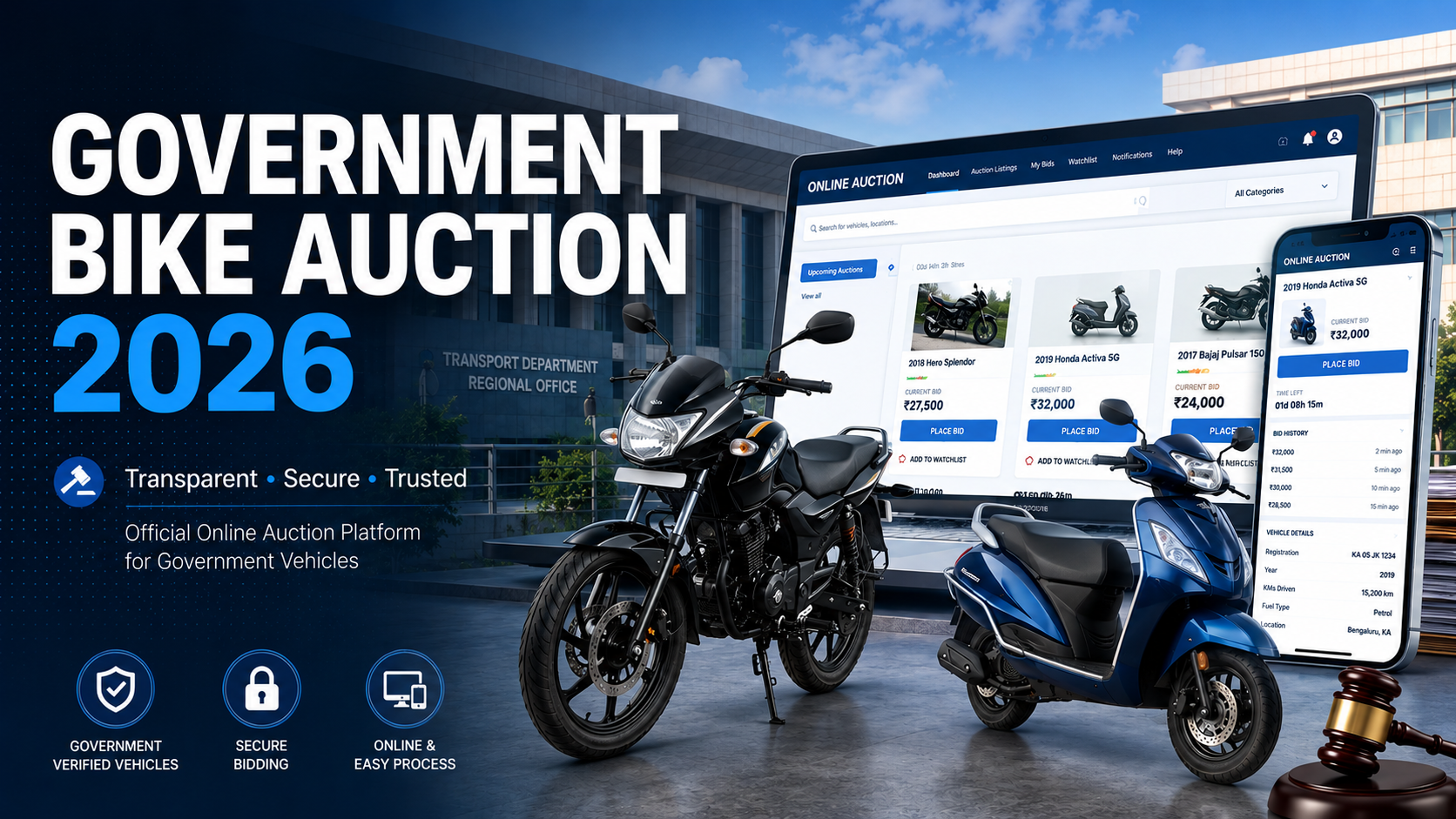
Government Bike Auction 2026: If you are planning to buy a two wheeler in 2026, you might have observed that the prices of the new bikes and scooters have increased tremendously.
Buying a new bike can leave a big dent in your wallet with rising production prices, higher taxes and hefty insurance premiums. Even the conventional used car market has been tagged with inflated prices. But what if there was a way to purchase a motorbike that was fully legal, transparent and unbelievably cheap?
Welcome to the world of Government Bike Auction 2026.
If you are a college student who is looking for a budget commuter or a motorbike enthusiast in search of a restoration project or even a scrap dealer looking for bulk purchases, government and police seized car auctions are the best place to find discounts of a lifetime. In this complete guide, we’re going to tell you all you need to know about navigating the government bike auction scene in 2026.
Government Bike Auction 2026: How It Works
Thousands of automobiles are every year acquired by various government departments. But how do they get there?
The bulk of the vehicles sold in government bike auctions come from three main sources:
- Police and Excise Seizures: Cars confiscated for engaging in illicit activities (such as smuggling or contravention of excise rules) or abandoned by their owners after serious traffic infractions.
- Customs Confiscations Customs authorities seize high-end motorcycles that are imported illegally or without proper payment of duty and auction them at a later date.
- Fleet Retirement from agencies: Government agencies, law enforcement departments and institutions (e.g. Supreme Court, postal services) often update their fleets and sell their older, used motorcycles by auction.
Instead than letting these two-wheelers rot in impound lots, the government sells them to the public to recoup storage costs and create cash. These sales are on a “As Is Where Is” and “As Is What Is” basis. Vehicles are offered as is with no guarantees.
Government Bike Auction 2026: What to Consider
Government vehicle auctions take a little more effort than just driving into a dealership, but the rewards are worth it.
1. Best prices
What makes these auctions attractive is the price tag. Base reserve prices are quite low since the government’s purpose is to clear away inventory, not make a large profit. In some recent 2026 auctions, beginning reserve prices for commuter bikes and scooters have been set for as cheap as a few thousand rupees, and scrap-condition motorcycles for even less.
2. A Variety Beyond Belief
You don’t have to be brand loyal. One auction catalogue has everything from run of the mill commuters like the Hero Splendour and Honda Shine to expensive cruisers like Royal Enfields and even iconic scooters like the TVS Jupiter and Honda Activa.
eAuctions India (eAI) Source:
3. Full Transparency
The days of back-room bargains are over. By 2026, the vast majority of government bike auctions are online through secure government portals. Electronic bidding ensures a level playing field for all bidders and prevents price fixing.
How to Find Government Bike Auctions in 2026
Government Bike Auction 2026 The first hurdle most buyers face is simply knowing where to look. Government auctions are not advertised on flashy billboards. Here are the top platforms and portals you need to monitor in 2026:
-
MSTC India (mstcecommerce.com): This is the premier e-commerce portal for the Government of India. It hosts auctions for the Customs Department, Excise Department, and various public sector undertakings.
-
GeM Portal (Government e-Marketplace): The GeM portal frequently hosts forward auctions for the disposal of old departmental vehicles.
-
eauction.gov.in: The centralized portal for various Indian government auctions, including property, goods, and vehicles.
-
State Police and Excise Websites: Individual state departments regularly publish auction notices on their official websites or in local newspapers.
-
Tender Aggregator Sites: Websites like TenderTiger aggregate auction notices from across the country, making it easier to filter by state and vehicle type.
Government Bike Auction 2026: Bidding Steps
If you’ve come across a notice of an auction that you’re interested in, here is the precise process that you need to go through to get that motorbike home.
Step 1: Registration & KYC
To participate in online auction (e.g. MSTC) you have to first register yourself as a buyer on the site. This requires inputting your details and doing a KYC (Know your Customer) process by utilising your PAN card, Aadhaar card and bank account details. Registration may require a small, non-refundable cost.
Step 2: Submit the Earnest Money Deposit (EMD)
The auctioning authority needs an EMD to verify that only serious purchasers are involved. This is a refundable amount to be paid before the auction date (typically by NEFT, RTGS or Demand Draft). If you win the auction, the EMD is reconciled with the ultimate purchase price. If you lose, your EMD will be credited to your bank account.
eAuctions India 4
Step 3: The Mandatory Inspection (Important Step)
Never bid blind. The auction notice will include dates and times for inspection in person at the impound lot or government office. The bikes are sold on ‘As Is Where Is’ basis, so you would have to visit the lot, check the engine condition, look out for rust, check the tyres and verify the chassis number against the catalogue.
eAuctions India
Step 4 Bidding Day
Login to the portal on the day of the auction. Usually bidding is done in a window of a few hours.
Pro Tip: Don’t submit your max bid right away. Just wait and see the bidding trends. Most portals include an Auto-Extension rule. If a bid is submitted in the last few minutes, the auction period will automatically extend (typically by 8 minutes) to give others an opportunity to counter.
eAuctions India Pvt.
Step 5: Pay and collect after the auction
You get an acceptance letter if you are the highest bidder and your bid is accepted. You usually have a hard deadline (generally 7-8 days) to pay the rest. Failure to do so, will result in the forfeiture of your EMD. Once complete payment and relevant GST is cleared, you will receive a Delivery Order for pickup of the vehicle.
India eAuctions
Major pitfalls to avoid
The scene of the 2026 Government Bike Auction is littered with deals, but also pitfalls for the unsuspecting buyer. And remember the warnings:Add Repair Costs: If a bike seems good on the outside, it may be seized on the inside, if it’s been sitting for 2 years. Always work out expected repair expenses before you figure out your maximum bid.
Pending Challans: Find out from the auctioning authority whether the pending traffic penalties on the confiscated vehicle will be waived off or the new buyer will have to take care of it.
The RC Transfer Process: The government will give you an auction sale certificate but it is your responsibility to get the Registration Certificate (RC) transferred at the local RTO. To avoid RTO headaches, make sure the chassis and engine numbers match the paperwork to the letter.
Parking Penalties: Once the Delivery Order is issued, you normally have a few days to get the bike off the lot. If this is delayed there will be significant ground rent charges to be paid daily.
Conclusion
Participating in a Government Bike Auction 2026 is one of the smartest financial decisions you can make if you are in the market for a two-wheeler. While it requires patience, due diligence, and a keen eye during the physical inspection, the thousands of rupees you save make the entire process incredibly rewarding.
Keep a close eye on the MSTC portal, monitor your local state excise websites, and never skip the physical inspection. With a bit of luck and smart bidding strategy, your next dream ride is just an auction away.
Have you ever purchased a vehicle through a government auction, or are you planning to bid in 2026? Let us know about your plans and questions in the comments below!